Acoustic Levitation Technology for Contactless Assembly of Precision Instruments"
Imagine assembling a delicate microchip or a sensitive medical device without a single physical touch. No risk of contamination, no microscopic scratches from tweezers, no static discharge from human hands. This isn't science fiction; it's the reality being shaped by acoustic levitation technology, a field that's rapidly moving from lab curiosity to industrial application.
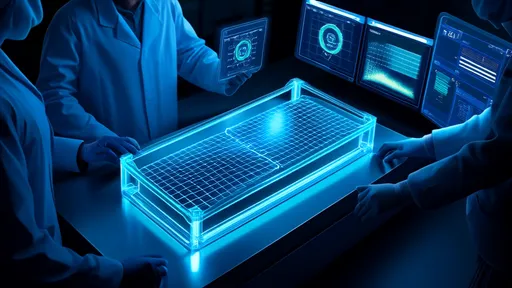
The core principle is both elegant and powerful. Sound waves, which are essentially pressure waves traveling through a medium like air, can be precisely manipulated to create nodes of minimal pressure. By using an array of ultrasonic transducers, engineers can generate a standing wave pattern. Small objects, from droplets of liquid to solid components, can be trapped in these low-pressure nodes, effectively suspended in mid-air against the force of gravity. It’s like catching an object in the eye of a silent, invisible storm.
For the assembly of high-precision instruments, the implications are profound. The most immediate benefit is the complete elimination of contact. In industries like semiconductor manufacturing or pharmaceuticals, where a single dust particle can ruin a product, non-contact handling is the holy grail. Components can be moved, rotated, and positioned with incredible accuracy, all while floating in a controlled, clean environment. This drastically reduces yield loss and improves the reliability of the final product.
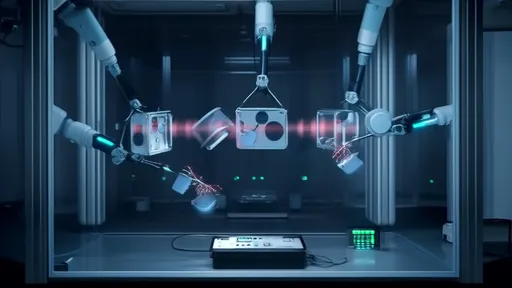
But how does this translate to an actual assembly line? The process isn't about magically waving components together. Sophisticated software controls the transducer arrays, creating dynamic acoustic fields. Think of it as programming a flight path in mid-air. A tiny screw can be lifted from a feeder, transported across a workspace, rotated to the correct orientation, and then gently lowered into its threaded hole—all without any physical grippers. The level of control is so fine that it can handle objects smaller than a pinhead.
One of the most exciting developments is the assembly of hybrid materials. Some advanced instruments combine very different components, like a fragile glass lens and a sensitive electronic sensor. Traditional robotic arms, even the most advanced ones, struggle with the varying compliance and fragility. Acoustic levitation, however, applies a uniform, gentle force regardless of the object's material properties. This allows for the safe and precise mating of parts that were previously considered too difficult or risky to automate.
Of course, the technology isn't without its current limitations. The primary challenge is scale. While it excels with miniaturized components, levitating larger, heavier objects requires a significant amount of energy and much larger transducer setups. Furthermore, the work environment needs to be carefully controlled, as strong air currents or temperature fluctuations can disrupt the delicate acoustic fields. Researchers are actively working on multi-axis systems and more powerful arrays to push these boundaries.
Beyond just moving parts, acoustic levitation is enabling processes that were once impossible. Consider applying a conductive adhesive to a micro-circuit. Instead of a nozzle that can clog or misapply, a droplet of adhesive can be levitated, shaped by the sound field, and then precisely deposited onto the target location. This opens up new avenues for micro-welding, coating, and even biological tissue engineering, where sterile, non-contact manipulation is paramount.
The journey from a fascinating physics demonstration to a viable industrial tool has been a long one, driven by relentless innovation in materials science, software, and acoustical engineering. What was once a party trick for levitating small beads of styrofoam is now a serious solution for some of the most demanding manufacturing challenges. The factories of the future may be far quieter and more graceful than the clanging, robotic assembly lines of today, with components silently floating into place.
As this technology matures, it promises to redefine precision itself. It’s not just about making existing processes better; it’s about enabling the creation of entirely new types of devices that were previously too complex or delicate to build. The ability to assemble without touch is more than a convenience—it's a fundamental shift that unlocks a higher tier of quality and innovation in advanced manufacturing.